The Great Loop of Togo
From voodoo coasts to Batammariba heights, Togo reveals its peoples and their thousand-year-old traditions.
Duration
14 days
From
€1,500/pers.
Ideal seasons
Jan, Feb, Mar, Nov, Dec
Style
Guided tour
Comfort
classique
Travelers
Couple, Solo, With friends, groupe
The spirit of travel
This grand two-week crossing of Togo is a true invitation to reverie and escape. From the coastal south to the mythical lands of the north, you embark on a journey to meet a warm-hearted people, in the heart of a mosaic of living cultures. Along the way, the multiple realities of Togo unfold with authenticity: the colorful hustle and bustle of traditional markets, the majesty of lush mountains and the freshness of tropical waterfalls. You will traverse centuries-old traditional villages and explore the Fazao-Malfakassa national park, a true preserved gem in the heart of the country. Between voodoo sanctuaries, dense forests and exceptional traditions, all the beauty and soul of Togo offer themselves to the traveler to amaze at every step. This complete circuit constitutes an unforgettable immersive break, designed to deeply understand all the nuances and richness of a country that is at once multiple, fascinating and complex.
The stages of your journey
Highlights
Day-by-day itinerary

Welcome to Togo!
Upon your arrival at the airport in Lomé, capital of Togo, you are welcomed by our local team, who will accompany you to your hotel for check-in.
Your coordinator guide will then present you with the program of your trip to Togo and provide you with the practical information necessary for a smooth stay. This first meeting is an opportunity to get to know your local team and calmly prepare the next stages of your journey.

Discovery of Lomé
After breakfast, you set off to discover Lomé, capital of Togo, the vibrant capital of Togo, where modernity and traditions coexist on a daily basis. Your visit begins at the great Assiganmé market, an unmissable hub of local life, where you discover the famous Nana Benz, these female traders renowned for their activity in the trade of printed fabrics. You continue your exploration at Lomé's craft market, a place conducive to discovering local craftsmanship and buying souvenirs. There you observe artisans at work and discover different traditional techniques, including batik, wood carving, engraving and weaving. An opportunity to appreciate the diversity of Togolese craft creations. Your journey then takes you to the fetish market, where you discover traditional pharmacopoeia and certain practices linked to local beliefs. You also set off to discover the historical and cultural heritage of Lomé, through several emblematic places in the capital, notably Liberty Square, Independence Square and the national museum of arts.
Finally, you head to Lomé's fishing port, where you observe the fishermen's activity and discover another facet of daily Togolese life.

Agbodrafo, memory of slavery
This morning, you set off to discover Agbodrafo, a former Portuguese city that has become a peaceful small town, located between the Lake Togo and the ocean. Once a slave trading port, Agbodrafo is part of the region historically known as the "Slave Coast". You explore the remnants of this past, notably the slave house (Woold Home) and the well of the chained, two places that bear witness to the history of the slave trade in the region. Your discovery continues in Glidji, a locality known for the ceremony of the taking of the sacred stone, a tradition rooted in the local cultural heritage.
You then dedicate half a day to meetings and exchanges with the inhabitants of Agbodrafo. This participatory moment allows you to share their daily life and discover their way of living through authentic exchanges, in a spirit of closeness and respect for local traditions.

Animism and Voodoo
After breakfast, you set off on an excursion to Togoville, a village steeped in history and traditions, whose name is at the origin of that of Togo.
To reach the village, you enjoy a crossing of Lake Togo in a traditional canoe, an opportunity to appreciate the landscapes that border the lake.
Upon your arrival, you discover the historical heritage of Togoville, notably its remains bearing witness to the period of slavery and colonization. This village is also distinguished by the coexistence of voodoo traditions and the Catholic religion, particularly present within the local population.
This excursion allows you to better understand the history and religious traditions that contribute to the cultural identity of Togoville.
Togoville → Avévé
You head towards the village of Avévé, where you meet with the inhabitants to discover their daily life and traditions.
This visit immerses you in the heart of local culture, deeply marked by the beliefs and practices of vodoun. Through exchanges with villagers, you discover the customs that hold an important place in their daily life.
Depending on availability, you may also witness traditional dances inspired by local culture, an opportunity to better understand the traditions and cultural heritage of the village.
Avévé → Aneho
Return to Aného and night in the same hotel.

Kpalimé, an authentic city in bountiful nature
You head towards Kpalimé, leaving behind the southern coast of Togo. Along the way, you meet communities settled on the mountain slopes after fleeing wars. These populations live mainly from intensive agriculture, and these exchanges allow you to discover their way of life and traditions.
Located in the heart of a region renowned for its coffee and cocoa crops, Kpalimé benefits from a natural environment composed of wooded hills and deep valleys. Nearby, the Agou peak, the highest point in Togo, stands out with its dense forests and small villages. The region is also home to several natural waterfalls suitable for swimming.
Kpalimé is also a major center of Togolese craftsmanship, where many artists and artisans meet: woodcarvers, batik artists, potters, weavers and artisans working with gourds.
Upon your arrival, you set off to discover the Womé waterfalls, accessible after a short car journey and a small walk through the forest. In this lush natural setting, you enjoy a moment of relaxation and a swim in the fresh waters of the waterfall, deep enough for a pleasant refreshing dip.

Hiking at Mont Agou
This day is entirely dedicated to discovering Kpalimé and its surroundings, between artisanal traditions, mountainous landscapes and meetings with local inhabitants.
You start with a visit to the Kpalimé market, a lively and colorful place where you discover the atmosphere of local life. You then head towards Mount Agou, which peaks at 986 meters altitude and is the highest point in Togo.
Your discovery continues at the Kloto artisanal center, where you visit different workshops and exchange directly with craftsmen. It's an opportunity to appreciate their craftsmanship and discover works of art made from tropical woods, particularly ebony, teak and mahogany.
You then set off on a hiking trip to meet villagers settled on the mountainsides. With their permission, you will be able to enter their homes and share a moment of exchange about their daily life.
Your walk takes you through a humid tropical forest, amid coffee and cocoa plantations. The trail runs along lush slopes, dotted with streams and springs, and offers beautiful panoramas of the surrounding landscapes. A hike that combines nature discovery and authentic encounters with local communities.

Atakpamé, the Mountain Refuge
You are heading today towards Atakpamé, a town perched on a hillside, in the heart of an agricultural region renowned for its coffee and cocoa cultivation. Together with Kpalimé and Badou, it forms the coffee-cocoa triangle of Togo.
Once a mountain refuge, Atakpamé became an agricultural and administrative center during the period of German colonization. The town preserves a cultural heritage marked by its traditions, notably the tchébé dance, a traditional dance on stilts emblematic of the region. With a bit of luck, you will have the opportunity to attend a performance and discover this expression of Togolese culture.
You continue your discovery at the central market of Atakpamé, located around the main square. This meeting and exchange place comes alive especially at nightfall, when music accompanies locals and visitors in a friendly atmosphere.
You also head to the Nangbéto dam, located near Atakpamé, where you may be able to observe hippopotamuses in their natural environment.

Badou and the Akrowa Falls
After breakfast, you head out on an excursion to Badou, a small town located near Atakpamé, in the heart of a lush valley surrounded by wooded hills and coffee plantations that extend across the hillsides.
In this region where agriculture plays an essential role, the inhabitants live mainly from farming the land and commerce. Upon your arrival, you set out to discover the coffee plantations and meet the locals to exchange about their daily life and agricultural activities.
In the afternoon, you reach Akrowa waterfall, nestled in the heart of the forest. Standing approximately 100 meters high, this waterfall with milky reflections cascades down a granite cliff into a natural pool. Its location, at the bottom of an isolated ravine, provides a setting conducive to discovery and relaxation.
You take advantage of this natural environment to enjoy a swim at the foot of the waterfall, surrounded by the forest vegetation.
At the end of the day, you head back to Atakpamé for the night.

From Kamina to Sokodé, Discovery of Kotokoli Culture and Local Traditions
After breakfast, you hit the road very early heading north to Togo. Your itinerary takes you through Kamina, before reaching Sokodé, your destination for the day. Sokodé, one of the country's main cities, is an administrative center where an important Kotokoli community lives, predominantly Muslim. The dress traditions there are reminiscent of those in North Africa: men wear large boubous, while women combine veils with outfits in varied colors.
The city is also distinguished by its musical traditions and local dances, which hold an important place in Kotokoli culture. During the knife festival, the streets come alive to the rhythm of music and traditional dances, bearing witness to the richness of the region's cultural heritage.
You continue your discovery by visiting private homes that shelter the tombs of warriors, to which locals continue to make regular offerings. This visit allows you to approach the beliefs and ancestral practices that are passed down within local communities.

Fazao-Malfakassa National Park
You depart to discover theFazao-Malfakassa National Park, located at the foot of theFazao-Malfakassamountain range. Spanning nearly 192,000 hectares, this natural space is home to a great diversity of landscapes, between forest galleries, fertile plains and vegetation formations with varied scents.
The park serves as a refuge for many animal species, notably buffalo, elephants, antelopes, hartebeest, kob and warthogs. It also welcomes a wide variety of birds, primates and reptiles, which contribute to the richness of its biodiversity.
During the dry season, from November to April, the park is open for visits and wildlife observation safaris, offering the opportunity to discover animals in their natural environment.
At the end of the day, you return to your camp inSokodéfor the night.

Bassar, Iron Civilization and Encounters with Traditional Chiefs
This morning, you head northwest towards Bassar, the first stop of your day. This region is known for its heritage linked to iron civilization, of which the Bassar are considered pioneers in this part of Africa.
Once there, you meet with traditional chiefs during visits centered on exchange and solidarity. You discover their large clay houses, where they play an important role in community life, particularly in resolving problems and disputes among residents.
These meetings offer you an insight into the social organization and local traditions, while fostering authentic exchanges with representatives of the Bassar community.
You continue your journey to the Batammariba country, located in northern Togo, whose architectural traditions are also found among the Somba, on the other side of the border, in Benin.
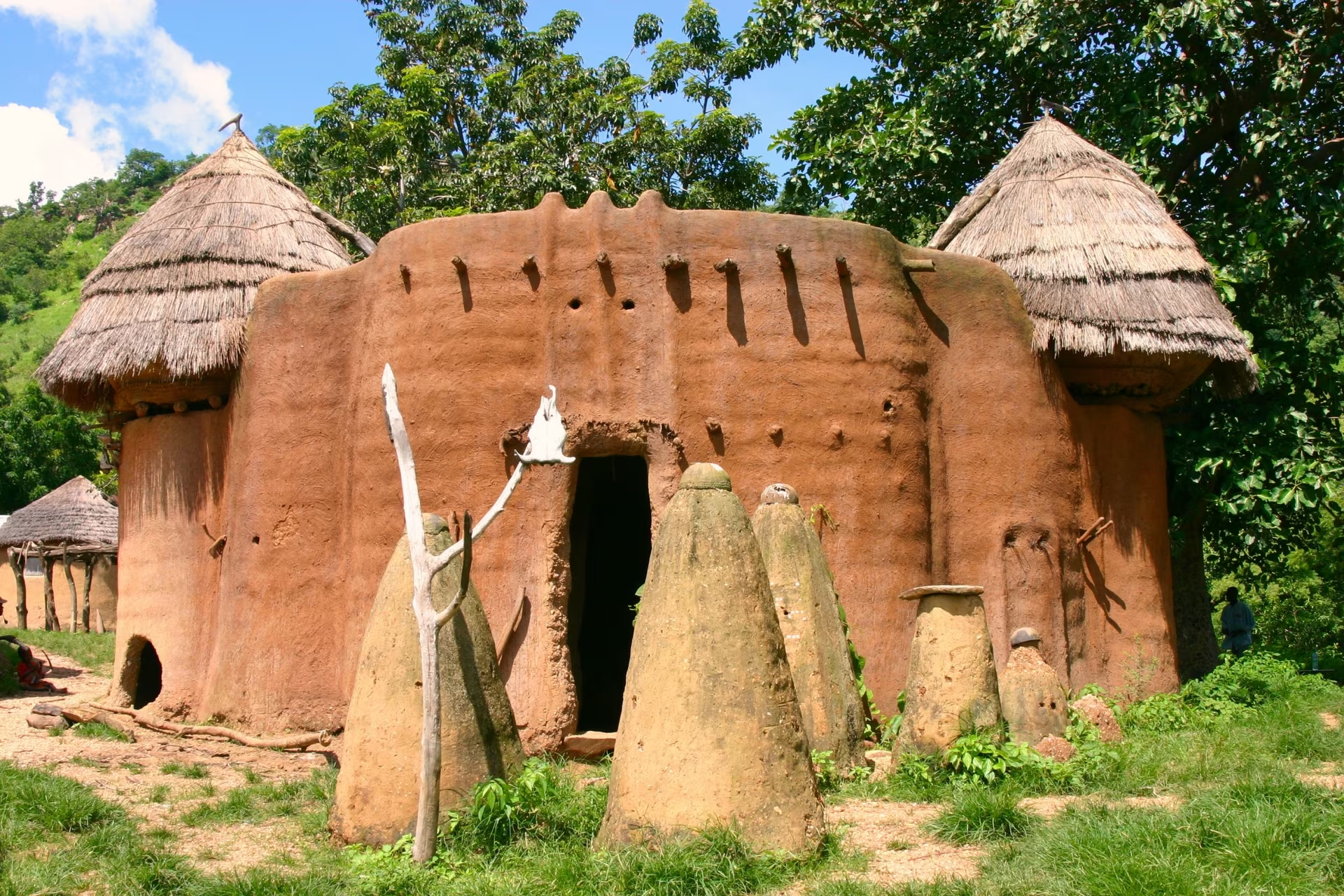
This region is distinguished by its traditional fortified houses, called tamberma. Built on several levels and equipped with terraces, these dwellings take the form of true fortress-farms. They are grouped in small villages of about ten constructions, corresponding to a family clan. Each dwelling is designed to house the family and all of its possessions.
In the heart of a village, you meet the Batammariba people to discover their way of life, their traditions and the construction techniques of these characteristic dwellings. You observe several types of tamberma houses and exchange with the inhabitants about their architectural expertise.
With their permission, you will also be able to enter certain traditional dwellings, an opportunity to better understand their organization and the daily life of the families.

The Kara region and the Kabyés
You are setting off to discover Kara, a rapidly developing city located in the heart of northern Togo. This region is home to a large Kabyé community, whose inhabitants are nicknamed the "stone farmers" because of their agricultural expertise on rocky terrain.
The Kabyés have developed diversified agriculture, particularly around the cultivation of yams, cotton and peanuts, as well as the production of mangoes and other fruits. You will also discover their traditional habitat, the Soukala, groups of huts surrounded by an enclosure wall, where a family lives organized according to a patriarchal model.
Your visit continues with meetings and exchanges with local artisans, particularly blacksmiths, whose craftsmanship holds an important place in the region's traditions. These moments of sharing allow you to better understand the traditional crafts and daily life of Kabyé communities.
If your trip takes place in July, you may have the opportunity to witness the traditional Evala festivals, initiation ceremonies that constitute an important cultural event for the Kabyé people.
You head south towards Togo's south, in the direction of Notsé, a region known for its pineapple crops.
Throughout the journey, several stops and visits allow you to discover the landscapes you pass through. You notably stop at the Aledjo fault, a rock formation characteristic of the region.
You then continue your journey towards Notsé, your destination for the day.

The Ewe Kingdom
You are discovering Notsé, considered the historical capital of the Ewé people. This city holds an important place in the history and traditions of this community, whose kingdom developed in the region around the 15th century.
Although few remains from this period survive today, Notsé remains a symbolic place for the Ewé. Every year, the city hosts Agbogbo-Za, a major traditional festival that testifies to the population's attachment to its history and cultural heritage.
You then meet with pineapple growers, a crop characteristic of the region. These exchanges allow you to discover their agricultural activity and daily life.
You continue your visit by discovering the historical remains of Notsé, witnesses to the ancient Ewé civilization. You then share lunch with the pineapple growers, a convivial moment conducive to exchanges and meetings.
In the evening, you return to Lomé, where you settle into your hotel for the night.

Have a good trip!
For this last day in Togo, you take advantage of your final hours on site to enjoy one last tour of Lomé, an opportunity to soak in the atmosphere of the Togolese capital one more time.
You continue with a stroll along the beach, a moment of relaxation and sharing to exchange about your discoveries, your meetings and the emotions experienced throughout your trip.
Before your departure, you still have some time to do some souvenir shopping and enjoy a refreshment.
It is then time to head to Lomé airport for your return flight, with many memories of your stay in Togo.
Price per person
Indicative price per person, based on double room. Each trip is customized according to your preferences.
This trip can be tailored to your preferences
This itinerary provides an excellent foundation for discovery, but it can be fully customized. Our local advisors build each trip tailored to your budget, dates and preferences.
Not included
- Flights
- Visa fees
- Insurance
- Meals and Beverages
- Tips and Personal Expenses
- The extras
Included
- The accommodations
- The services of an English-speaking coordinator guide
- Transportation throughout the entire stay (driver and fuel included)
- The mentioned activities
- Site entries
Practical Information
Registration is considered firm and final after payment of a deposit of 30% of the total price and acceptance of the specific terms of sale.
The balance must be paid no later than 45 days before the departure date.
See our specific terms of sale for full details.
In the event of cancellation by the traveller, the following fees apply:
- Plus de 60 jours avant le départ : 40 % du prix total (acompte retenu)
- Entre 60 et 30 jours avant le départ : 50 % du prix total
- Moins de 30 jours avant le départ : 100 % du prix total
We strongly recommend taking out cancellation insurance. See our specific terms of sale for full details.
The information below concerns travelers who are nationals of the European Economic Area (EEA), Switzerland, and Canada traveling to Togo for a leisure trip. Entry rules may change, so we recommend verifying this information with official authorities before departure.
Passport
To enter Togo, your passport must be valid for a minimum of six months after the date of entry into the country and must contain at least one blank page for immigration stamps.
The document must be in good condition (no damaged, torn, or altered pages).
Visa
Nationals of the European Economic Area, Switzerland, and Canada must obtain a visa to enter Togo. This visa can be obtained through two methods:
the electronic visa (e-visa), which must be requested online before departure through the official Togolese authorities portal,
the visa on arrival, available at Gnassingbé Eyadéma International Airport in Lomé, subject to meeting the required conditions.
The tourist visa is generally granted for a stay of up to 30 days, with the possibility of an extension through Togolese immigration services.
Authorities may request:
an exit ticket from the territory (return flight or onward journey),
proof of sufficient financial resources for the duration of your stay,
an accommodation booking.
Yellow Fever Vaccination Certificate
Presentation of an international yellow fever vaccination certificate is mandatory for entry to Togo. This document must be valid and comply with World Health Organization (WHO) standards.
It is recommended that you obtain this certificate before departure, as its absence may result in entry denial or quarantine upon arrival.
Health
Apart from yellow fever vaccination, it is advisable to consult a doctor or vaccination center before departure. Other vaccinations may be recommended depending on your personal situation (hepatitis A and B, typhoid, meningitis, etc.).
Togo is a malaria-risk country: antimalarial preventive treatment is strongly recommended. The use of insect repellents and insecticide-treated mosquito nets is also advised.
Traveling with Children
Minors must hold their own valid passport covering the duration of the stay, as well as a valid visa.
In certain European countries, when a minor travels without one of their parents, an exit authorization from the territory may be required according to the regulations of the country of residence.
Other Nationalities
Entry conditions may vary depending on nationality. Affected travelers should inquire with the Togolese embassy or consulate in their country of residence.
To participate in our trips, it is strongly recommended to have evacuation assistance and foreign medical expenses coverage.
Your local agency encourages you to review the specific policy developed with our partner CHAPKA ASSURANCES and AXA ASSISTANCE.
To purchase insurance, learn about coverage and rates, follow the link below.
CAP EXPLORER: The complete insurance solution designed for a worry-free trip!
Choose the plan that suits you best:
Explorer'Multirisque
Explorer'Annulation
Explorer'Assistance
Explorer' Complémentaire Carte Bancaire
Specific to our trips, we strongly recommend subscribing to them.
If you choose to subscribe to one of these plans, the policy detailing all coverage and claim procedures are available on the insurer's website.
Your local agency will be aware of it, but only the participant is responsible for complying with claim notification procedures. The participant must therefore keep this policy with them throughout their trip.
Chapka — Cap Explorer
Our insurance partnerTravel with peace of mind with our partner Chapka. Cancellation, repatriation, medical expenses, baggage… All the coverage for a worry-free trip.
Travel with peace of mind — I'll handle the insuranceFrequently asked questions
A tourist visa is required. It can be obtained on arrival at Lomé airport or online (e-visa). Your passport must be valid for at least 6 months and a yellow fever vaccination certificate is mandatory. Before booking your trip, check with your country's consular authorities for the specific conditions applicable to your nationality.
Go to the My Trips section to find all your projects.
You can send a message to your host directly from the Tea Lounge.
For a tailor-made quality trip, plan for 120 to 210 euros per day and per person, including accommodation, meals, internal transfers and English-speaking guide. International flights (600-1000 euros return) are additional. Togo offers an authentic experience, often combined with Benin.
Your documents are accessible in the Documents tab of your trip.
Absolutely. We tailor each itinerary to your travel profile. For families, we prioritize relaxed pacing, family-friendly accommodations, educational and fun activities, and comfortable private transfers. Our English-speaking local guides know how to capture children's attention with age-appropriate anecdotes.
It's simple. You exchange with our local team to define your wishes, budget and dates. You receive a detailed itinerary proposal within 48 hours. You adjust together every detail until you reach the perfect version. You confirm and travel with peace of mind. Your local agency remains available 7 days a week throughout your trip.
In case of emergency, contact your local agency immediately.
Payment is generally made in two installments.
Our agency is part of the Nomadays network, registered in France. You benefit from APST (Association Professionnelle de Solidarité du Tourisme) coverage, which protects 100% of your funds. Secure payment, repatriation insurance included, and English-speaking assistance 24/7 on the ground throughout your stay.

Let's talk about your adventure — Lomé Coastal
Custodian of Togolese traditions, based in Lomé
Togo is a country of encounters above all. It's often the simplest exchanges that leave the strongest memories.
— Isaac