Togo & Benin: Culture, Nature and Voodoo
On the trails of the kingdoms of Abomey and Somba villages, between voodoo rites and age-old traditions of the Gulf of Guinea.
Duration
15 days
From
€1,700/pers.
Ideal seasons
Jan, Feb, Mar, Nov, Dec
Style
Guided tour
Comfort
classique
Travelers
Couple, Solo, With friends, groupe
The spirit of travel
Two countries in a single journey: Togo and Benin. This itinerary is an invitation to discover two neighboring territories, united by a history, traditions and cultures that echo across their borders. From Lomé to the kingdoms of Benin, you will meet peoples with strong identities and living heritage, where ancestral practices remain deeply rooted in daily life.
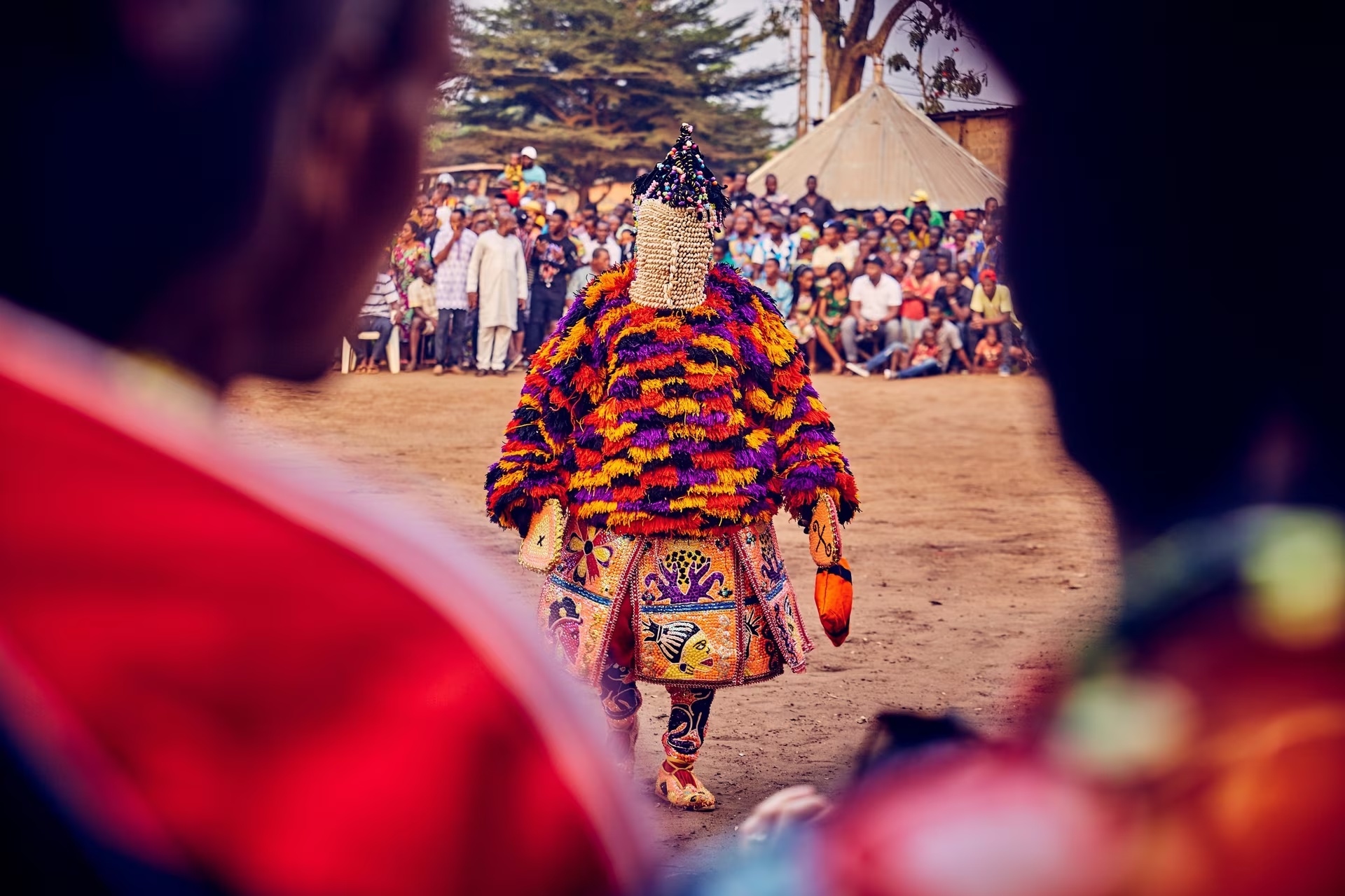
Traditional dances, sacred rhythms, remote villages, voodoo rites, scarifications, night vigils and authentic encounters will punctuate these two weeks of immersion in West Africa. Between historical sites, varied landscapes and privileged exchanges with local populations, this journey will allow you to better understand the cultural richness of these two countries while living deeply human experiences.
An intense, authentic and unforgettable itinerary to discover the soul of Togo and Benin.
The stages of your journey
Highlights
Day-by-day itinerary


Discovery of Lomé
After breakfast, we set off on a tour of the city of Lomé, the lively capital of Togo where modernity and traditions blend together.
At the great Assiganmé market, we discover the Nana Benz, famous traders of printed fabrics.
The craft market is the ideal place to buy souvenirs. The discerning visitor can discover valuable items there and observe the artisans at work: batik, wood carving, engraving, weaving, …
Finally, the fetish market opens the doors to traditional pharmacopoeia.
Lomé is also home to great monuments such as Liberty Square, Independence Square or its famous national arts museum. We don't forget to take a tour of the fishing port, where fishermen are always there.

Kpalimé, an authentic city in generous nature
We leave the south coast today heading towards Kpalimé. Along the way, we visit and meet with peoples who, fleeing wars, live on the mountainsides and practice intensive agriculture.
A region of coffee and cocoa, Kpalimé is located in a natural environment of great beauty surrounded by hills with thick forests and deep valleys. The Agou peak (Togo's highest summit) is covered in dense forests and dotted with small villages. Many natural waterfalls allow for refreshment by the water. Kpalimé is also the country's most important craft center, where a large number of artists and craftspeople have settled: woodcarvers, batik artists, potters, weavers, calabash makers, …
Upon arrival, we visit the Womé waterfalls, which we reach after a short drive followed by a short walk through the forest. The place is idyllic for swimming, with water that is sufficiently deep and pleasantly cool!

Hiking at Mont Agou
The entire day is dedicated to the discovery of Kpalimé and its surroundings. After a tour of its very lively and colorful market, we head towards the Mont Agou, which, at 986 meters altitude is the highest point in the country. The Kloto craft center with its various workshops will also be on our program. It is one of the best places to exchange directly with craftsmen and purchase tropical wood art objects: ebony, teak, mahogany.
Hiking on foot among villagers living on the mountainside. With their permission, we will enter their homes. The humid tropical freshness of the forest, cocoa fields, coffee fields, on slopes often bordered by streams, springs and especially beautiful panoramic views, … the walk is enchanting !
Return to Kpalimé for the night.

History of Slavery
This morning we visit Agbodrafo, a former Portuguese town that has become a quiet little city nestled between Lake Togo and the ocean. A former slave trading port located 30 kilometers from Lomé, it has been recognized as part of the "Slave Coast".
You can discover some remains of this past such as the slave house (Woold Home) or the well of the chained, as well as the locality of Glidji, site of the ceremony of taking the sacred stone. We devote a good half-day of participation and exchange in the daily life of Agbodrafo's inhabitants.

Ouidah, gateway to Benin
This morning we transfer to the city of Ouidah, close to the Atlantic coast, our gateway to Benin.
We dedicate the day to long hours of strolling through this historic city and begin with the Python Temple. It stands opposite the Basilica of the Immaculate Conception, the city's cathedral, with which it forms a striking contrast.
Then we stretch our legs by exploring the sacred forest of Kpassé. It is a wooded area where century-old trees stand tall. We enjoy discovering its voodoo temple with its statues of voodoo deities, as well as contemplating the king's iroko tree.
The Slave Route remains an unmissable circuit in Ouidah. We walk several kilometers of beach to retrace one by one the 5 stages of this path, symbol of the slave trade in Benin.
We end our visit to the city with a brief stop at the Zinsou foundation to admire contemporary African art.

Lakeside City of Ganvié and Porto Novo
Ouidah (Bénin) → Ganvié (Bénin)
We then head towards the lakeside city of Ganvié. This village is located in the middle of Lake Nokoué and has been inhabited since 1770 by the Toffin, a tribe that fled inter-ethnic conflicts and the evils of slavery. The spectacle that unfolds before our eyes is exceptional: its floating market with a thousand colors and a thousand scents, and its bamboo and straw houses on stilts. The tour is done by canoe.
Ganvié (Bénin) → Porto Novo (Bénin)
Then we head to Porto Novo, the administrative capital of Benin. It is also the capital of the Ouémé department. This beautiful and charming port city stands out for its multi-ethnicity and especially for the colonial architecture of its buildings, listed as UNESCO World Heritage sites (such as its Grand Mosque).
An African city known as the heart of cults devoted to the god Orisha, three distinct religions predominate there: Christianity, the Yoruba religion and Voodoo, and Islam.
We visit the Honmé palace, before continuing with some history and culture at the ethnographic museum. You can admire various indigenous artifacts there such as Guèlèdè masks, weapons and musical instruments. The Grand Mosque proves to be a real feast for the eyes with its multicolored facades and architectural style.

Discovering the Kingdom of Abomey
Porto Novo (Bénin) → Abomey (Bénin)
On the road to Abomey, we pass through Pobé to pay a courtesy visit to the "Holi" women and admire their traditional adornments and tattoos. It is one of the rare ethnic groups that still preserve their cultures.
Former capital of Dahomey, the city of Abomey is home to the royal palaces of ancient kings. Founded in the 16th century, Abomey houses the museum that preserves ancient royal objects, ornaments and treasures of the former kingdom. The sites were abandoned following the defeat of King Behanzin against French colonists. Later, these castles were renovated by UNESCO and became historical museums.
We visit Goho Square and we take a break at the Hountondji specialists in the transformation and manufacture of gold and copper objects.

Towards Northern Benin
Abomey (Bénin) → Dassa-Zoumé (Bénin)
We are heading north today and making a first stop in the historic town of Dassa-Zoumé. Impressive rocky hills surround the town, forming a natural amphitheater of great beauty called the 41 hills.
Dassa-Zoumé (Bénin) → Natitingou (Bénin)
Before Natitingou, we make a second stop at Djougou to visit the village of Taneka Koko, located in the heart of a region mainly occupied by animist hunters and millet farmers.
Arrival at Natitingou and accommodation for the night.

In Somba Country
Natitingou (Bénin) → Boukoumbe (Bénin)
Before leaving Natitingou, we visit the folk museum and the city market. It is also possible to take a bath in the natural pool of Kota Falls.
On the road leading to Boukoumbe are villages whose population is essentially agricultural. Boukoumbe is one of the nine municipalities in the Atacora department, not far from the border with Togo. We are in Somba country, a region where people lived naked and apart from the rest of the world until the 1960s. It was not until 1975 that the government "civilized" this pagan people, notably through schooling.
A few kilometers from Boukoumbe, we arrive at the small village of Koutagou, which in the Somba language means "where there is happiness". This village is known for its Somba tatas, traditional constructions that command admiration. But beyond these veritable strongholds, the small village of Koutagou offers a plain suitable for hiking and exchanges with the local population. We can also admire the peaks of the Atakora which, in the distance, challenge us…

On the other side of the border, the Batammariba country
Continuation towards the famous Batammariba country which is none other than the counterpart, on the Togolese side, of the Somba country in Benin. The houses there are original fortified farm-fortresses with stories characterized by their fortified forms with terraces. They are grouped in small villages of about ten units corresponding to a clan, essentially in the north of Togo and Benin. They are built to contain everything the head of the family possesses. In the heart of the village, discovery of the tamberma with the population to see the construction techniques, the way of life of the Batammariba people and visit several types of tamberma. With their permission, we will enter their houses.
A city in full expansion, Kara is at the heart of visiting Northern Togo. It is here that we find one of the most numerous ethnic groups in Togo, the Kabyés or "stone farmers", because they practice agriculture on rocky terrain. The Kabyés have made the region an important agricultural center where yams, cotton, peanuts are grown, and where mangoes and other fruits are found. Their houses called Soukala are a collection of huts united by an enclosure wall where only a single patriarchal family lives. Meeting and exchanges with craftsmen, particularly blacksmiths. Possibility of attending in July of each year the traditional festivals Evala, an initiation festival.

Sokodé
Sokodé is one of the largest cities in Togo. It is an administrative center where the Kotokolis live in majority, Muslims whose clothing is reminiscent of North Africa. The men wear large boubous and the women wear veils over magnificent colorful outfits. Local music and dances are not found anywhere else in Togo. During the knife festival, the streets fill with traditional music and dances.
Visit and discovery of certain private houses (warrior tombs) to which regular offerings are still made.

Atakpamé, the mountain refuge
We are now heading towards Atakpamé.
Atakpamé is a prosperous town perched on a hill that completes the coffee-cocoa triangle formed by Kpalimé, Badou and Atakpamé. Once, the town was a mountain refuge. Later, during German colonization, the town became an agricultural and administrative center. With a bit of luck, you can witness a tchébé dance performance on stilts. It is one of the most famous dances in Togo and one of the region's specialties.
The central market is located around the main square of the town. As night falls, the square becomes more lively and buyers as well as visitors walk to the beat of the music.
At the Nangbéto dam located not far from the town, we can observe hippopotamuses.
Notsé and the Ewe People
Notsé is the capital of the Ewe people. Few traces remain of the kingdom that developed there around the 15th century, but Notsé remains a mythical place for many Ewe, as evidenced each year by the greatest traditional festival of the Ewe people: Agbogbo-Za.
Meet with pineapple growers. Visit historical remains, witnesses to Ewe civilization. Lunch with the pineapple growers.

Have a great trip!
Price per person
Indicative price per person, based on double room. Each trip is customized according to your preferences.
This trip can be tailored to your preferences
This itinerary provides an excellent foundation for discovery, but it can be fully customized. Our local advisors build each trip tailored to your budget, dates and preferences.
Not included
- Air transport
- Visa fees
- Insurance
- Meals and drinks
- Tips and Personal Expenses
- The extras
Included
- Accommodation
- The services of an English-speaking coordinator guide
- Transportation throughout the entire stay (driver and fuel included)
- The mentioned activities
- Site entrances
Practical Information
Registration is considered firm and final after payment of a deposit of 30% of the total price and acceptance of the specific terms of sale.
The balance must be paid no later than 45 days before the departure date.
See our specific terms of sale for full details.
In the event of cancellation by the traveller, the following fees apply:
- Plus de 60 jours avant le départ : 40 % du prix total (acompte retenu)
- Entre 60 et 30 jours avant le départ : 50 % du prix total
- Moins de 30 jours avant le départ : 100 % du prix total
We strongly recommend taking out cancellation insurance. See our specific terms of sale for full details.
The information below concerns travelers who are nationals of the European Economic Area (EEA), Switzerland, and Canada traveling to Togo for a leisure trip. Entry rules may change, so we recommend verifying this information with official authorities before departure.
Passport
To enter Togo, your passport must be valid for a minimum of six months after the date of entry into the country and must contain at least one blank page for immigration stamps.
The document must be in good condition (no damaged, torn, or altered pages).
Visa
Nationals of the European Economic Area, Switzerland, and Canada must obtain a visa to enter Togo. This visa can be obtained through two methods:
the electronic visa (e-visa), which must be requested online before departure through the official Togolese authorities portal,
the visa on arrival, available at Gnassingbé Eyadéma International Airport in Lomé, subject to meeting the required conditions.
The tourist visa is generally granted for a stay of up to 30 days, with the possibility of an extension through Togolese immigration services.
Authorities may request:
an exit ticket from the territory (return flight or onward journey),
proof of sufficient financial resources for the duration of your stay,
an accommodation booking.
Yellow Fever Vaccination Certificate
Presentation of an international yellow fever vaccination certificate is mandatory for entry to Togo. This document must be valid and comply with World Health Organization (WHO) standards.
It is recommended that you obtain this certificate before departure, as its absence may result in entry denial or quarantine upon arrival.
Health
Apart from yellow fever vaccination, it is advisable to consult a doctor or vaccination center before departure. Other vaccinations may be recommended depending on your personal situation (hepatitis A and B, typhoid, meningitis, etc.).
Togo is a malaria-risk country: antimalarial preventive treatment is strongly recommended. The use of insect repellents and insecticide-treated mosquito nets is also advised.
Traveling with Children
Minors must hold their own valid passport covering the duration of the stay, as well as a valid visa.
In certain European countries, when a minor travels without one of their parents, an exit authorization from the territory may be required according to the regulations of the country of residence.
Other Nationalities
Entry conditions may vary depending on nationality. Affected travelers should inquire with the Togolese embassy or consulate in their country of residence.
To participate in our trips, it is strongly recommended to have evacuation assistance and foreign medical expenses coverage.
Your local agency encourages you to review the specific policy developed with our partner CHAPKA ASSURANCES and AXA ASSISTANCE.
To purchase insurance, learn about coverage and rates, follow the link below.
CAP EXPLORER: The complete insurance solution designed for a worry-free trip!
Choose the plan that suits you best:
Explorer'Multirisque
Explorer'Annulation
Explorer'Assistance
Explorer' Complémentaire Carte Bancaire
Specific to our trips, we strongly recommend subscribing to them.
If you choose to subscribe to one of these plans, the policy detailing all coverage and claim procedures are available on the insurer's website.
Your local agency will be aware of it, but only the participant is responsible for complying with claim notification procedures. The participant must therefore keep this policy with them throughout their trip.
Chapka — Cap Explorer
Our insurance partnerTravel with peace of mind with our partner Chapka. Cancellation, repatriation, medical expenses, baggage… All the coverage for a worry-free trip.
Travel with peace of mind — I'll handle the insuranceFrequently asked questions
A tourist visa is required. It can be obtained on arrival at Lomé airport or online (e-visa). Your passport must be valid for at least 6 months and a yellow fever vaccination certificate is mandatory. Before booking your trip, check with your country's consular authorities for the specific conditions applicable to your nationality.
Go to the My Trips section to find all your projects.
You can send a message to your host directly from the Tea Lounge.
For a tailor-made quality trip, plan for 120 to 210 euros per day and per person, including accommodation, meals, internal transfers and English-speaking guide. International flights (600-1000 euros return) are additional. Togo offers an authentic experience, often combined with Benin.
Your documents are accessible in the Documents tab of your trip.
Absolutely. We tailor each itinerary to your travel profile. For families, we prioritize relaxed pacing, family-friendly accommodations, educational and fun activities, and comfortable private transfers. Our English-speaking local guides know how to capture children's attention with age-appropriate anecdotes.
It's simple. You exchange with our local team to define your wishes, budget and dates. You receive a detailed itinerary proposal within 48 hours. You adjust together every detail until you reach the perfect version. You confirm and travel with peace of mind. Your local agency remains available 7 days a week throughout your trip.
In case of emergency, contact your local agency immediately.
Payment is generally made in two installments.
Our agency is part of the Nomadays network, registered in France. You benefit from APST (Association Professionnelle de Solidarité du Tourisme) coverage, which protects 100% of your funds. Secure payment, repatriation insurance included, and English-speaking assistance 24/7 on the ground throughout your stay.

Let's talk about your adventure — Lomé Coastal
Custodian of Togolese traditions, based in Lomé
Togo is a country of encounters above all. It's often the simplest exchanges that leave the strongest memories.
— Isaac